Editorial disclosure: This is a non-paid, non-sponsored editorial analysis. There is no affiliate arrangement, advisory role, or commercial relationship between The Audrey Aesthetic and V-Unite. The platform was selected for coverage because of its architectural significance to the AI-in-aesthetics category.
AI in Training Has Been a Promise. V-Unite Is Shipping It.
Owners in medical aesthetics have been hearing the same pitch for years: AI is coming for training. AI will personalize onboarding. AI will reduce ramp-up time. AI will surface skill gaps before they cost you a patient. The pitch has been credible. The product has not.
Most of what has shipped is a chatbot bolted onto a corporate learning management system that was built for sales teams at insurance companies. Generic, retrofitted, and largely indifferent to how an aesthetic practice actually runs. Owners have bought into it, watched their staff disengage, and quietly returned to senior nurse shadowing and PDF protocols held together by goodwill.
V-Unite is the first aesthetics-vertical platform to ship an AI training architecture that is worth the conversation. Not as a feature. As infrastructure.
Who Built It
V-Unite was built by Stephen Handisides through Handi Media, the company behind the Global Virtual Aesthetic Summit (GVAS). The leadership bench is notable for an industry-specific platform: ex-Allergan, ex-Galderma, and ex-Zenoti commercial talent sit on the senior advisory and operating team. This is not a generic LMS that discovered aesthetics. This is a company that has operated inside the industry for over a decade.
What an AI-Native Training Platform Actually Looks Like
V-Unite’s AI suite is built as three connected layers. Each one solves a different operational problem. Together they form an architecture that no other aesthetics-facing training platform has shipped at this scale.
Layer One: Unite AI — the Data Layer
Unite AI is the foundation. It connects to HRIS, CRM, ERP, practice management systems, and spreadsheet exports through API integrations. It cleans, structures, and unifies fragmented operational data into a single intelligence model.
For an aesthetic practice, this is the first time training data and operational data sit inside the same system. Completion records from the LMS. Appointment data from the practice management platform. Lead conversion data from the CRM. Staff performance metrics. All of it feeds one model instead of living in five disconnected dashboards.
Layer Two: AI Performance Agent — the Predictive Layer
The AI Performance Agent analyzes the unified data and produces predictions. It scores skill readiness across roles. It flags at-risk learners before they fail competency assessments. It identifies which training modules correlate with measurable performance improvement. It recommends interventions in real time.
For a multi-site group, this is the difference between knowing your new injector completed the advanced filler module and knowing whether that completion correlates with their patient rebooking rate at the 90-day mark. One is training data. The other is operational intelligence.
Layer Three: AI Tutor — the Learner Layer
Every learner inside V-Unite gets a personalized AI learning companion. The AI Tutor provides real-time question and answer support inside training modules. It adapts difficulty based on learner progress. It surfaces micro-learning tasks tailored to individual gaps. It scales 1:1 tutoring across thousands of users simultaneously.
For onboarding a new injector, this means the AI Tutor can answer protocol questions the moment they arise, pulled from the practice’s own SOPs rather than generic content. Training stops being a static experience and becomes an interactive one.
The Aesthetic-Specific Layer
Generic AI training tools fail in aesthetic workflows because they were not built for clinical context. They cannot distinguish between an OSHA refresher module and a Botox dilution protocol. They have no scaffolding for scope of practice rules that change state by state. They treat patient interaction the same way they treat software demos.
V-Unite’s vertical-first design is the part that makes the AI useful. The platform was built around aesthetic workflows from the ground up. Provider education, distributor training, sales onboarding, compliance certification, virtual product launches, and HCP engagement all sit inside one architecture designed for this industry.
Without the aesthetic-specific layer, the AI is sophisticated but generic. With it, the AI is sophisticated and operational.
The Immersive Environment That Looks Like Your Practice
This is the part that surprises owners during a demo. V-Unite builds branded, immersive 3D environments that visually replicate the practice itself. Virtual clinic spaces, treatment rooms, front desk areas, product galleries, conference rooms. New hires walk into a digital version of the workspace they will actually work in.
Training engagement collapses when the environment feels disconnected from the work. A new injector clicking through a corporate slide deck in a generic dashboard never builds the spatial and visual context that real clinical work requires. V-Unite’s immersive layer changes that. The environment reinforces brand standards visually, not just textually. For multi-site groups, every location operates from the same branded training environment that mirrors clinical reality.
Combine the immersive layer with the AI layer and the result is something new in this category: training that looks like the practice, adapts to the learner, and connects back to operational data.
One Platform, Not Five
Most aesthetic practices currently run training through some combination of Trainual for SOPs, Loom for video walkthroughs, Calendly for live training sessions, a compliance tracker for regulatory documentation, and a separate certification log buried in a shared drive. None of these systems talk to each other. None of them feed an analytics layer. None of them produce a single source of truth for who is trained, certified, and ready to work.
V-Unite consolidates training, onboarding, compliance, sales enablement, product education, certifications, and virtual events into one platform. The operational benefit is not just convenience. It is the data architecture. Unified systems produce unified data, and unified data is what makes the AI layer above it actually useful.
The AI Feature Breakdown by Pricing Tier
V-Unite’s AI suite is structured across three pricing tiers. The full architecture sits at the Enterprise level, with AI capabilities available as optional add-ons at lower tiers. The table below breaks down what is included where.
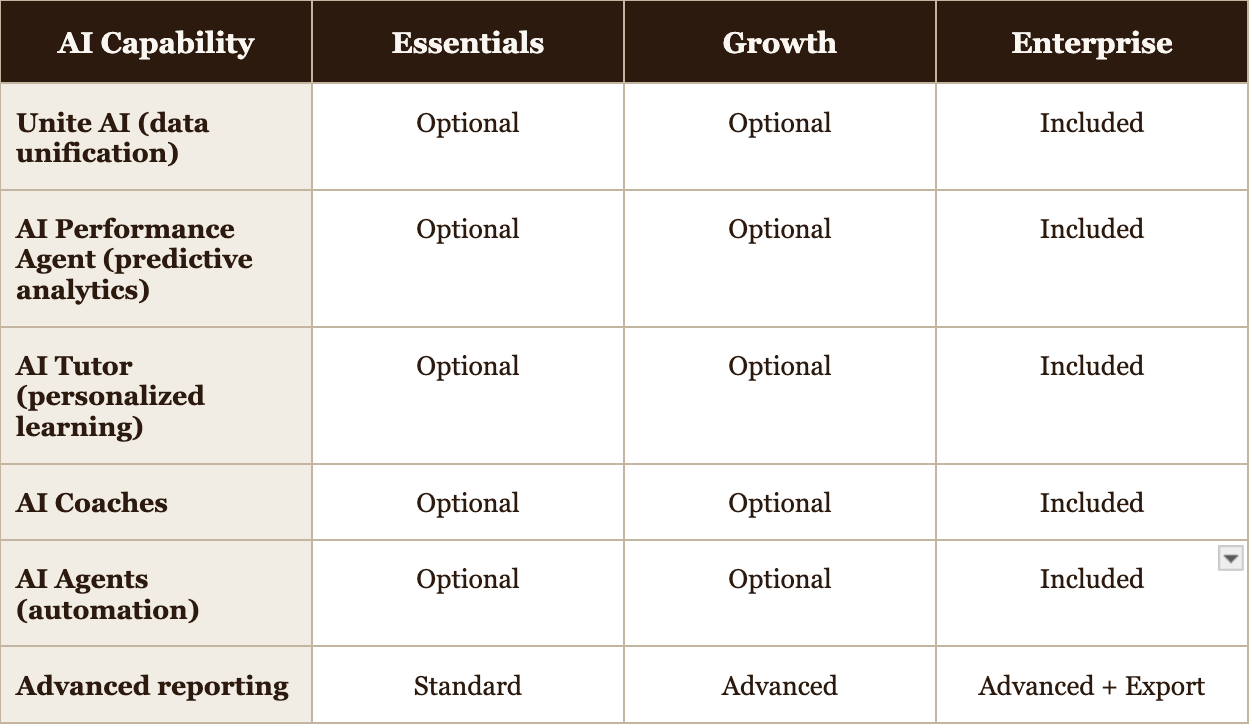
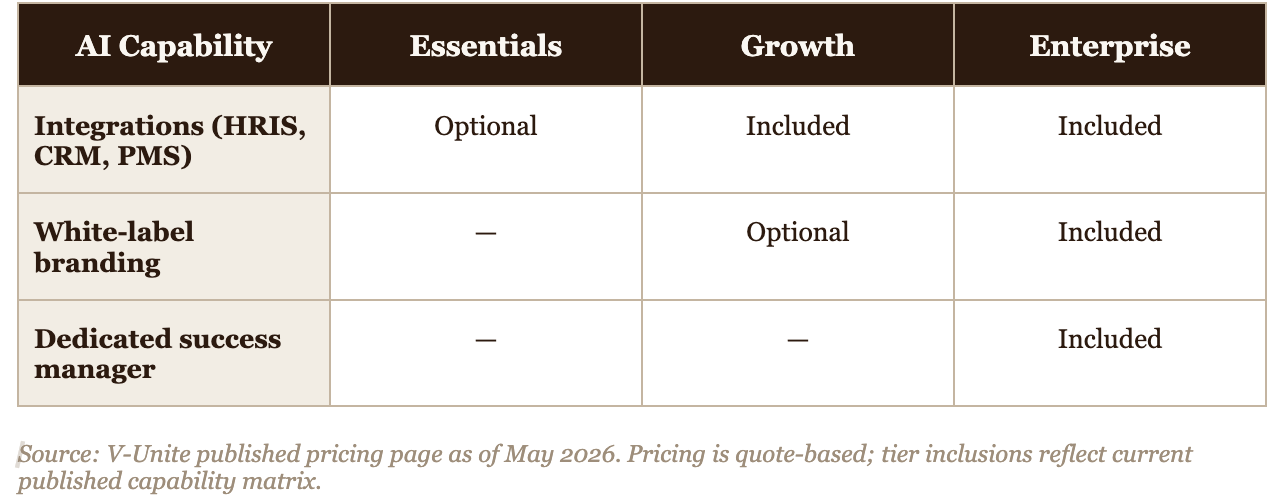
The honest operator read: the full three-layer AI stack is the Enterprise story. Multi-site groups, franchise systems, PE-backed platforms, and manufacturer training programs are the operators who get the most from this architecture. For these owners, the AI layer scales with the operation and compounds as more data feeds the system.
For smaller practices, the value sits in the immersive environment, the unified platform, and the optional AI modules that can be activated as the operation grows. The architecture is built to expand with the business.
What This Means for Owners Right Now
The owners paying attention to this category early are building a structural advantage that compounds. Training infrastructure is one of those operational layers that looks invisible from the outside and impossible to retrofit once the practice scales past a certain size.
The Case for Multi-Site and Franchise Operators
If you operate across multiple locations, the cost of inconsistent training shows up everywhere: variable patient outcomes, inconsistent brand experience, compliance gaps that surface only during audits, slow onboarding when a new location opens. V-Unite’s architecture is built specifically to solve this. One platform, one branded environment, one data layer, one analytics view across every site.
The Case for PE-Backed Platforms
Private equity rollups depend on standardization to protect margin. The platforms acquiring single-site practices and stitching them into multi-state groups need training infrastructure that can absorb acquisitions, standardize protocols, and produce defensible compliance documentation across the portfolio. V-Unite’s data unification layer is built for exactly this use case.
The Case for Manufacturers and Device Brands
Companies training reseller networks, distributor partners, and provider customers across multiple regions and languages have historically managed this through expensive in-person summits and underused webinar libraries. V-Unite consolidates the full enablement workflow into a single branded environment with AI-driven engagement analytics. The published case studies from Colorescience, Marini, DermapenWorld, and Revian point directly to this use case.
The Case for Serious Single-Site Practices
Single-site practices that are growing fast, planning to expand, or preparing for acquisition should at minimum understand what this category looks like. The training infrastructure you build now becomes the foundation you operate from in three years. The AI capabilities scale with the operation; the platform decision compounds.
The Category Signal
V-Unite’s significance extends beyond V-Unite as a single platform. The architecture itself signals that AI in training is moving from feature to infrastructure inside aesthetic operations. The question for owners is not whether AI belongs in training. That question is settled. The question is which platforms ship a coherent architecture and which ship a chatbot.
The competitors worth watching: Trainual with AI add-ons, practice management platforms layering training modules on top of their core systems, generic enterprise LMS vendors pushing aesthetic verticals. None of them currently match V-Unite’s depth across the three-layer AI architecture combined with the immersive environment and the aesthetic-specific design. That may change in the next 18 months. For now, V-Unite is the platform setting the standard.
Final Take
This is a non-paid editorial position. V-Unite is the most architecturally serious training platform the aesthetic industry has seen, and the three-layer AI stack is the reason. The immersive environment, the unified platform, the vertical-first design, and the leadership bench all support that architecture. They do not replace it.
The recommendation for owners: every multi-site CEO, franchise operator, PE-backed platform leader, and serious single-site practice owner should at minimum sit through a V-Unite demo and ask hard questions about integration with existing practice management and CRM systems. The platforms that can connect operational data to training data are the platforms that turn training from cost center into competitive advantage.
Training was a back-office problem for the last twenty years. AI is making it a strategic one.
The Audrey Aesthetic
theaudreyaesthetic.com · @theaudrey_aesthetic · theaudreyaesthetic.substack.com
Audrey Campbell, MPH · audrey@theaudreyaesthetic.com