BEFORE WE START
This is not a feature comparison. There are dozens of those. They are largely useless to operators.
This is an account of what changed operationally when I shifted my AI workflow from ChatGPT to Claude — what worked, what I underestimated, and what the switch revealed about how most practices are using AI wrong.
The tool is almost never the problem. The architecture around it is.
The way most operators use AI is not a workflow.
It is a search habit.
Open a tab. Type a question. Get an answer. Close the tab.
That pattern is not AI integration. It is a slightly faster version of Googling. And it produces proportionally similar results: disconnected, decontextualized, and dependent on the quality of the question, not the quality of a system.
In aesthetics, this creates a specific and costly problem. Our operations are not generic. They involve credentialing requirements, service-specific protocols, consent frameworks, multi-provider staffing structures, tiered pricing logic, and compliance obligations that vary by state and modality. None of that context lives in a single prompt.
When you treat AI as a search engine, you are making the operator — you — the system. The AI is just producing on demand.
That is not leverage. That is a slightly upgraded copy-paste function.
The invisible tax: context rebuilding
Here is the cost that most operators never calculate.
Every time you open a new conversation with a general-purpose AI tool — without persistent context, without structured memory, without a system prompt that encodes your operation — you spend time rebuilding the architecture from scratch.
Who you are. What your practice looks like. What protocols govern your services. What your staff structure is. How you handle consent and documentation. What compliance frameworks apply to you.
That is not a one-time cost. It is a recurring labor tax on every AI-assisted task you complete.
Rebuilding context is not a minor inconvenience. Multiplied across a team and a week, it is a measurable margin drain.
When I started mapping how much time was spent on this in my own workflow, the number was uncomfortable. Fifteen minutes per session does not sound significant. Across twenty sessions a week, it becomes meaningful. Across a five-person team, it becomes a line item.
What I was actually missing
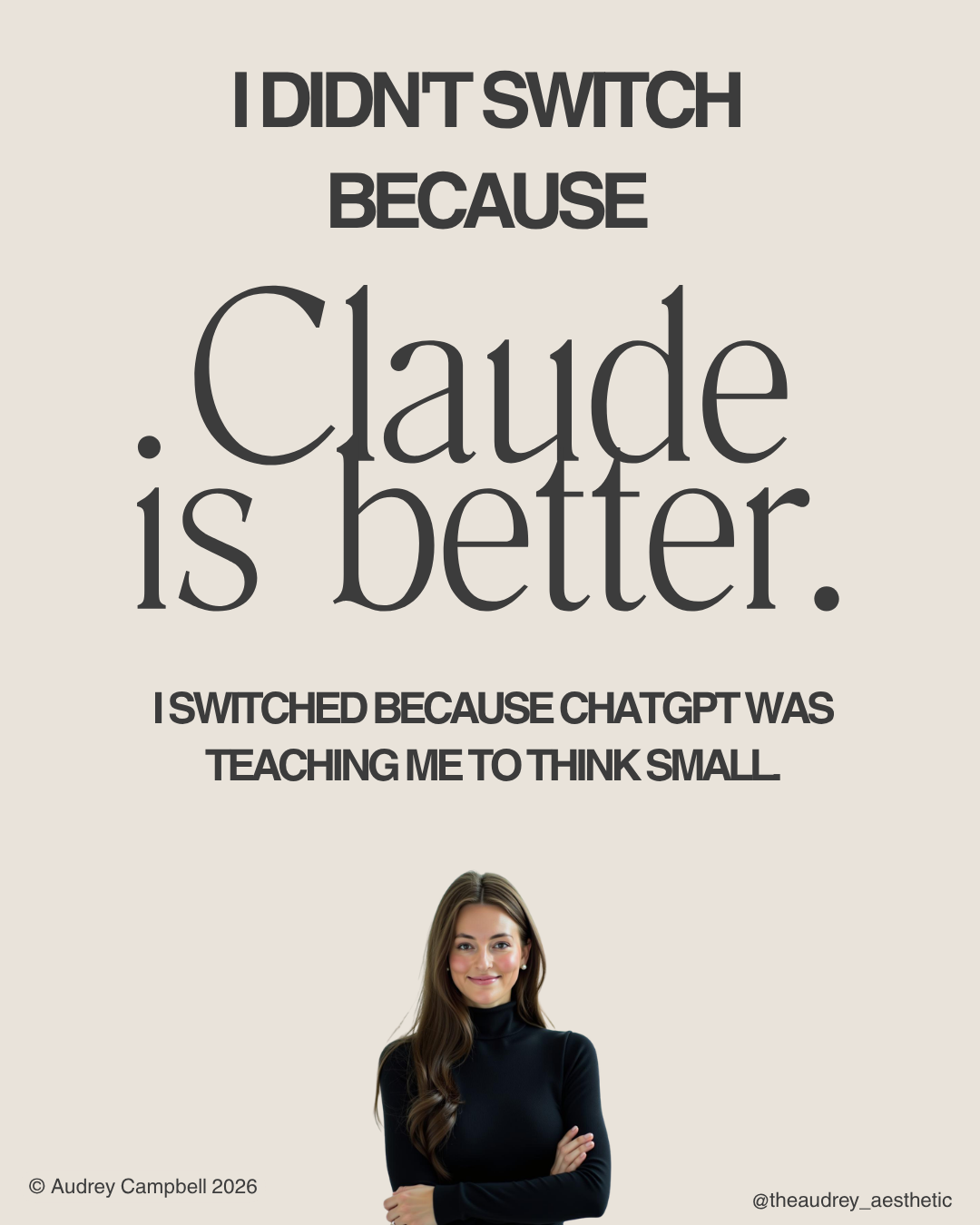
I did not switch because someone told me Claude was better. I switched because I started understanding what I actually needed from an AI tool in an operational context — and realized I had been optimizing for the wrong variable.
I had been optimizing for output quality on individual prompts. That matters. But it is not the constraint.
The constraint is: can this tool hold a complex, multi-layered operational context across an extended task — and reason within it, not around it?
That requires three things that most benchmark comparisons do not measure:
- Multi-step reasoning across a single extended session
- Protocol-aware output — responses that are calibrated to your specific operating parameters, not generic best practices
- Sustained context depth — the ability to hold a full operational framework and produce outputs that are coherent with it, without the operator re-anchoring every ten minutes
These are not prompt engineering problems. They are architecture problems. And they require a different relationship with the tool.
What changed when I moved to Claude
The shift was not dramatic on day one. It became apparent over two to three weeks of sustained use — specifically when I started using Claude for longer, more complex operator tasks, not one-off requests.
1. Documentation and protocol work
The single largest operational improvement. When building out staff training documentation — service protocols, injection technique references, consultation frameworks, patient communication templates — Claude held the structure of the document across the full drafting process. I did not need to re-anchor it to my practice’s service philosophy, credential requirements, or tone standards on every section.
The output was structurally coherent in a way that required fewer editorial passes. Not because Claude writes better prose. Because it maintained the architecture of the document better across a long task.
2. Compliance language and consent documentation
This is an area where operators cannot afford drift. Drafting or updating consent frameworks, service-specific disclosures, and protocol documentation requires careful, consistent language. That language needs to be calibrated to your specific services, your state’s regulatory environment, and your practice’s positioning.
Claude’s extended context window allowed me to work through a full consent review — multiple documents, multiple service categories — without losing the governing framework between sessions when I structured it correctly.
3. Financial narratives and operational summaries
For operators who interface with lenders, investors, or private equity, the ability to produce coherent financial narratives is material. This is not about generating numbers. It is about producing language that accurately represents your operation’s structure, margin logic, and growth thesis in a way that holds together.
Claude’s tendency to reason through problems rather than pattern-match to expected outputs made this category of work meaningfully better.
4. Multi-document synthesis
Pulling together information across an SOP library, a compensation structure document, a service menu, and a training framework — and producing something coherent from all of it — requires that the tool can work across a large context without degrading. This is where the practical difference became most visible in my workflow.
What did not change, and what still depends on you
Claude is not a replacement for operator judgment. I want to be direct about this.
The quality of your AI output — regardless of tool — is a direct function of the quality of the context you provide. A well-structured system prompt that encodes your practice’s operating parameters, your brand voice, your compliance environment, and your service philosophy will produce better outputs than any tool switch on its own.
You are not choosing between a good AI and a bad one. You are choosing which AI can best execute against the infrastructure you build around it.
If you are not building that infrastructure — if every session starts from zero — then switching tools will produce marginal improvement at best. The constraint is not the model. The constraint is the absence of a system.
ChatGPT works well for operators who have built that system around it. Claude works well for operators who have built that system around it. The model that holds extended context better gives you more margin for error, and more capacity for complex tasks. But it does not replace the architecture.
The question worth asking
When operators ask me which AI tool they should use, I have started asking a different question back:
What are you using AI to do?
If the answer is primarily content generation — social media, emails, marketing copy — then both tools are capable, the differences are mostly stylistic, and the choice is largely personal preference.
If the answer is operational infrastructure — documentation, compliance, training systems, financial language, multi-step workflows — then tool selection starts to matter. Not because one tool is smarter, but because the demands of that work expose the architectural differences between tools.
Most operators are underutilizing AI because they are using it for the first category and calling it integration. Real integration is the second category. That is where the operational leverage is. That is what this series has been about.
For operators evaluating this shift
Before changing tools, assess your current architecture:
- Do you have a system prompt or context document that encodes your practice’s operating parameters?
- Are you using AI for extended, multi-step tasks — or primarily single-prompt requests?
- Is your team using AI consistently, or ad hoc?
- Have you documented the workflows where AI output quality directly affects patient experience or compliance?
If you answered no to the first three questions, tool selection is not your constraint. Building the system around the tool is.
If you are already operating with that infrastructure and finding consistent limitations in extended or complex tasks, the switch is worth a structured evaluation period — not a wholesale immediate migration, but a deliberate test against your actual highest-value use cases.
Where this fits in the series
This installment sits at the intersection of every prior part: the operational systems from Parts 1 and 2, the financial and forecasting frameworks from Part 3, the marketing infrastructure from Part 4, the integration architecture from Part 5, and the hiring and documentation work from Part 6.
AI tool selection only matters in context. That context is your operation. The better you have built your operation — the clearer your protocols, the more defined your workflows, the more structured your documentation — the more any capable AI tool will return to you.
The tool is not the strategy. Your operation is the strategy. The tool executes against it.
Build the system. Then choose the tool that can run inside it.
CONTINUE READING
The full AI in Aesthetics: The Real Stack series is published at AestheticallyAudrey.substack.com. Each part covers a distinct operational domain. All content is operator-grade and free from affiliate incentive.
© Audrey Campbell 2026
@theaudrey_aesthetic · AestheticallyAudrey.substack.com