To be clear: I am not paid by MarketStorm, I have no financial incentive of any kind, and I have not implemented this platform in a practice. This is my honest assessment based on their AmSpa panel, a conversation with their team, and independent research.
What I Saw at the AmSpa AI Tech Summit
I want to be honest with you upfront. I attended their panel at the AmSpa AI Tech Summit in Las Vegas, talked to their team, and left with a perspective I need to share. What I do have is eight-plus years of watching practices invest heavily in marketing and still struggle to acquire new patients at a cost that makes the math work. And MarketStorm is doing something I have not seen anyone else do in this space.
Evaluate everything through the lens of your specific practice, your market, and your current operational priorities. One tool at a time.
The Problem Nobody Talks About: You Are Firing Too Late
Most aesthetics marketing operates at the bottom of the patient decision funnel. Google Ads. Meta campaigns. Retargeting pixels. These are all valuable, and I am not suggesting you abandon them. But they share a structural limitation: they reach people who have already made a decision. The patient who types ‘Botox near me’ into Google has already decided they want Botox. They have already formed opinions about what results look like, what a good practice feels like, and approximately how much they are willing to pay. At that point, you are competing for someone who already knows what they want, and so is every other practice in your market running a Google campaign.
The cost of that competition is not theoretical. Cost-per-click in aesthetics is high and rising. Conversion rates on cold traffic campaigns remain challenging. And in a softening consumer spending environment, the patients who are most easily reached at the bottom of the funnel are also the most price-sensitive, because they are actively comparison-shopping.
The practices that win in a tightening market are not the ones spending the most at the moment of search. They are the ones who were already familiar before the search began.
This is the problem MarketStorm is solving, and the concept they use to frame it is called the ‘messy middle.’
What the ‘Messy Middle’ Actually Is
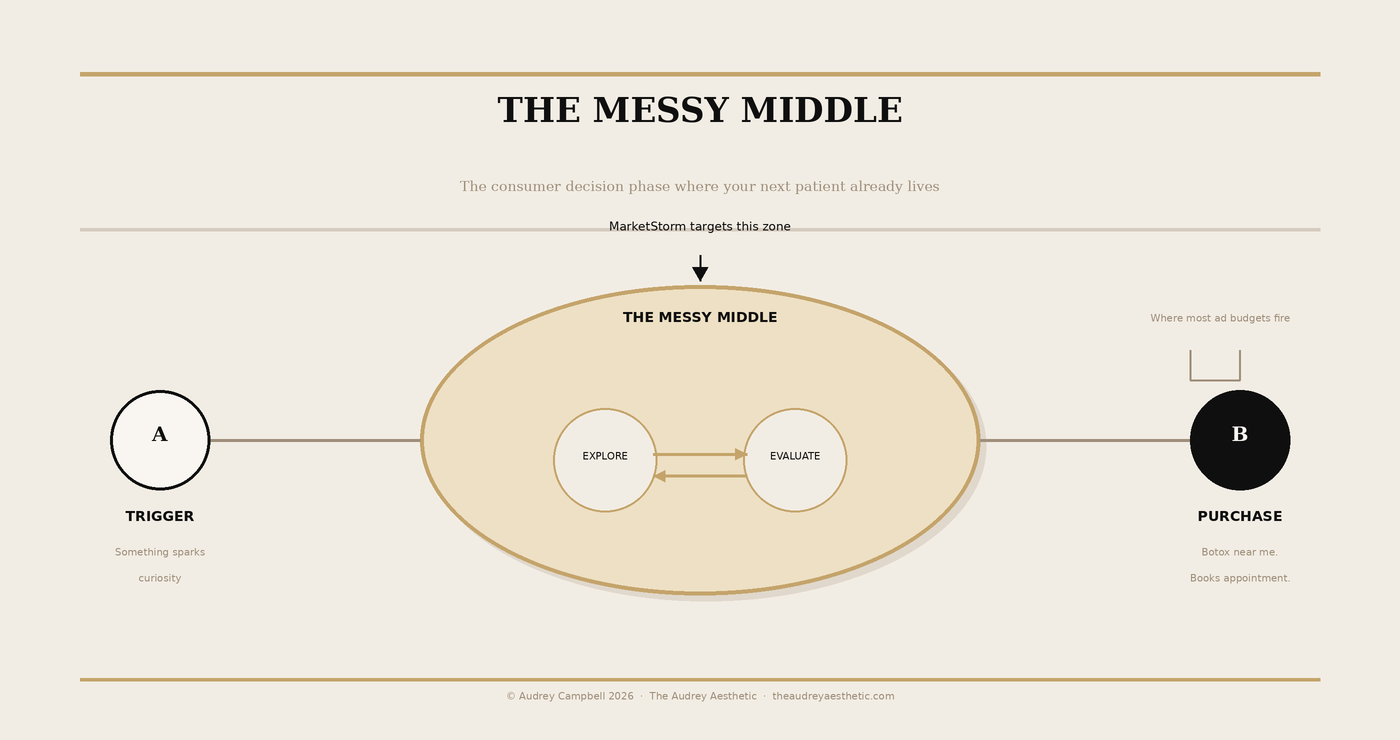
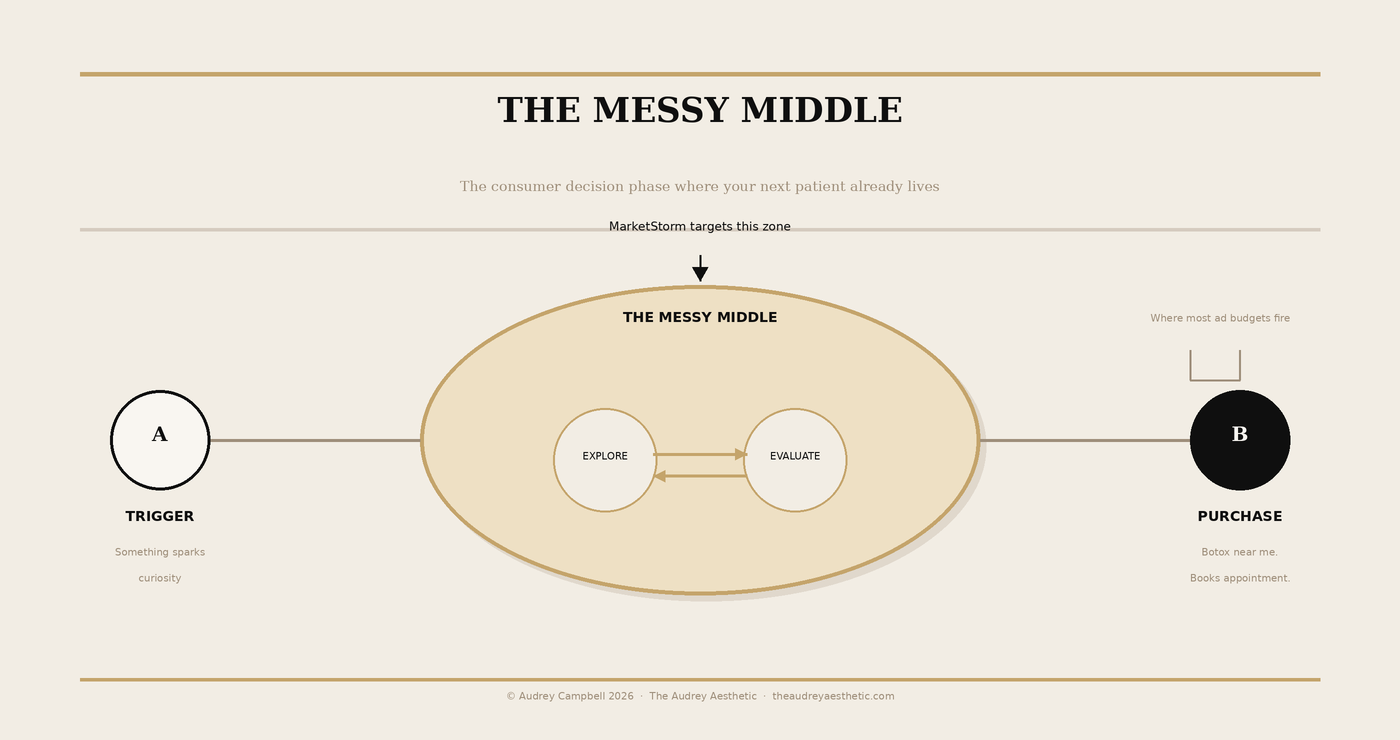
The messy middle is not a MarketStorm invention. It comes from Google’s consumer behavior research — specifically their ‘Decoding Decisions’ study — which found that between the moment a consumer becomes open to a category and the moment they make a purchase, they enter a looping decision phase. They explore (searching, browsing, discovering options) and they evaluate (comparing, reading reviews, processing brand impressions), cycling between those two modes multiple times before ever reaching a purchase decision.
The length and depth of that loop varies by category. For aesthetic treatments — where the decision involves the body, clinical trust, investment, and visible results — that loop can last weeks or months. A patient who will book a filler appointment in September may have first become open to the idea in June. She has been absorbing impressions of providers, absorbing brand signals, and forming preferences during those three months. Most practices were invisible to her during that entire window.
The diagram below maps this journey: a trigger ignites curiosity, the patient enters the messy middle where she explores and evaluates in cycles, and eventually the decision crystallizes into a purchase. Traditional advertising fires heavily at the right side of that diagram, near the moment of search. MarketStorm is built to operate in the center.
How MarketStorm Works
MarketStorm is an AI-driven programmatic advertising platform that has been operating since 2018. They describe their specialty as dominating the messy middle through custom-built AI algorithms and programmatic ad placement at scale. Here is what that means in practice.
Custom algorithm per client, not generic audience data
Most programmatic advertising relies on third-party audience segments — pre-packaged pools of users categorized by demographics or stated interests that any advertiser can purchase. MarketStorm does not work that way. Their data scientists build a proprietary algorithm for every client individually, drawing on real-time browsing behavior to construct a custom audience unique to your practice and your market. Their internal data shows this approach outperforms standard third-party audiences three to one on the same ad exchanges.
Channels: everywhere your patient is relaxing, not just where she is searching
Because MarketStorm is not competing at the moment of search, they are placing ads in environments where patients are not yet in decision mode: native placements in editorial content, display ads across the open web, connected TV and streaming platforms, digital audio, and in-app and in-game environments. These are the places where someone absorbs brand impressions before she ever knows she is forming preferences about you. The creative does not need to close a sale. It needs to establish recognition, warmth, and credibility so that when she eventually does search, your practice is already familiar.
The model: upper-to-mid funnel as infrastructure, not as a replacement
MarketStorm is explicit that they are not a substitute for your SEO, your Google Ads, or your social strategy. They position themselves as a layer that operates upstream of those channels, building the brand familiarity that makes your bottom-of-funnel spend more efficient. A patient who has already seen your brand multiple times in her content feeds is more likely to click on your Google ad, more likely to read your reviews, and more likely to convert when she arrives on your website.
Why This Matters Right Now for Aesthetic Operators
Consumer spending in aesthetics is tightening. That is not a prediction; it is something practitioners across the country are reporting. In a softening market, the instinct is to double down on direct-response advertising — discount promotions, urgency-based social ads, aggressive Google bidding. That strategy has diminishing returns when every practice in your market is doing the same thing and patients are more price-sensitive than usual.
The operators who come out of this cycle in the strongest position are unlikely to be the ones who competed hardest for the same bottom-of-funnel patient. They are more likely to be the practices that built brand familiarity during the soft period so that when patient confidence and discretionary spending recover, they are the recognized, trusted option. Getting upstream of the decision is a structural advantage, and in a moment when many competitors are retrenching their marketing, there is an argument that the cost of building that awareness is actually lower.
What to Evaluate Before Committing
Because I have not yet implemented this in a practice, I want to be disciplined about what I am and am not claiming. Here is what I would want to know as an operator before moving forward:
- Is your bottom-of-funnel marketing already optimized? Programmatic brand awareness amplifies a foundation that already converts. If your Google campaigns, website, and consultation process are not performing, adding upper-funnel spend will not fix the underlying problems.
- What does your patient acquisition economics look like today? Upper-funnel investment has a longer payback cycle than direct-response. Practices with immediate cash flow pressure may not have the runway to see returns from brand-building spend.
- How competitive is your local market? The messy middle argument is strongest in markets where multiple practices are competing for the same search queries and CPCs are elevated. In a less competitive market, the calculus is different.
- What is the minimum viable engagement? Ask MarketStorm about what realistic campaign minimums look like for a single-location practice versus a multi-site group. The answer will determine whether this belongs in your current budget cycle or your next one.
None of these are reasons to dismiss the approach. They are the questions I would ask before committing budget, and I would encourage you to ask them directly when you connect with their team.
How to Learn More
If you want to go deeper on the concept before reaching out, I would recommend starting with the Medical Spa Insider podcast episode titled ‘Mapping the Med Spa Customer Journey’ (Episode 416, March 2026, hosted by AmSpa founder Alex Thiersch). Rick Brown and Krista Stevenson walk through the messy middle framework in detail and explain how the platform applies specifically to medical aesthetics. It is a 34-minute conversation and a good way to evaluate whether the approach fits your marketing strategy before investing time in a demo.
When you are ready to talk to the team directly, reach out through the contact form on their website. I will include the link below. Tell them what your current marketing stack looks like and what problem you are trying to solve. The conversation will be more useful if you go in with a specific question rather than a general inquiry.
marketstorm.ai —
Medical Spa Insider Podcast, Ep. 416
Final thought.
The platforms that are winning the marketing game in aesthetics right now are not necessarily the ones with the biggest social following or the highest ad spend. They are the ones whose brand was already familiar when the patient finally decided to search. The messy middle is where that familiarity is built. Whether MarketStorm is the right tool for your practice in this budget cycle or the next one, the underlying principle is worth understanding.
Evaluate your biggest problem. Layer in one tool or system at a time. And always ask what happens to your patient volume if you stop spending tomorrow — because the answer tells you a lot about where your real leverage is.
Audrey Campbell, MPH is the founder of The Audrey Aesthetic (theaudreyaesthetic.com), a thought leadership platform publishing operator-grade content on AI implementation for the medical aesthetics industry. All tool coverage reflects independent evaluation. No paid partnerships are in place with any platforms discussed.