There’s a predictable arc most med spas follow.
Launch with momentum. Hit $1M in revenue within 18 months. Stabilize somewhere between $1.2M and $1.8M. Then plateau.
The owners blame market saturation, competition from dermatology practices, or “changing consumer behavior.” They increase Instagram spend, launch promotions, hire another injector.
Revenue bumps briefly. Then flattens again.
The problem isn’t market conditions. It’s that the business model itself has a built-in ceiling most operators never see until they hit it.
The Operational Ceiling
Med spas plateau because they optimize for appointments instead of outcomes. They build systems designed to fill the schedule, not to maximize patient value.
This works in the beginning. Early growth comes from new patient acquisition. But once the market knows you exist and your calendar reaches 60–70% capacity, growth stalls. You can’t fit more appointments, and your average patient isn’t spending enough to move the revenue line.
High performers don’t hit this ceiling because they build differently from the start. They focus on five operational levers most med spas ignore until it’s too late.
The Metrics That Determine Your Ceiling
Average Ticket: $1,240
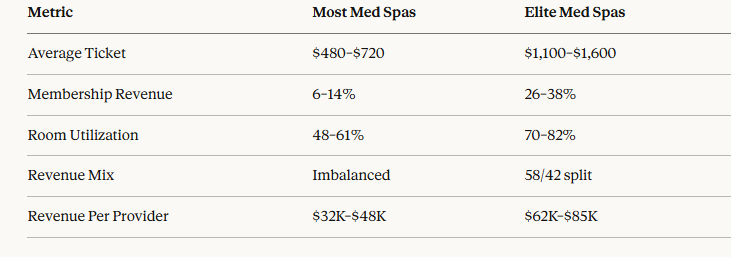
Most med spas generate $480–$720 per transaction. Top-quartile practices average $1,240. Elite practices consistently exceed $1,400.
The difference isn’t pricing. It’s packaging.
Low-ticket practices sell individual services. High-ticket practices sell treatment plans. One is transactional. The other is transformational.
When average ticket is low, it means your consultation process isn’t converting patients into multi-session plans. You’re leaving them to self-direct their care, which defaults to one-off purchases.
Membership Revenue Contribution: 29%
High-performing med spas generate 29% of total revenue from membership programs. Most generate 6–14%.
This gap is everything. Membership revenue is predictable. It stabilizes cash flow. It increases visit frequency by 240%. It raises annual patient value by 290%.
Practices that don’t hit 25%+ membership contribution are dependent on new patient acquisition every month. That makes them vulnerable to seasonality, competition, and marketing inefficiency.
When membership contribution is low, it’s because the program is positioned as a discount club instead of an exclusive care model. Discounts attract price-sensitive patients. Exclusivity attracts committed ones.
Room Utilization: 74%
Elite med spas convert 74% of available treatment room hours into billable time. Most are at 48–61%.
Room utilization reveals capacity efficiency. When it’s low, you’re either under-scheduled (demand problem) or over-built (infrastructure problem).
The fix isn’t more rooms or more marketing. It’s better service design and scheduling systems that keep existing capacity full.
Revenue Mix: 58% Injectables / 42% Devices
Most med spas skew heavily toward one revenue stream—either 70%+ devices or 80%+ injectables.
Elite med spas maintain a 58/42 split. This balance creates operational stability. Injectables provide margin. Devices provide volume and membership hooks. Together, they compound.
When revenue mix is imbalanced, the business becomes vulnerable. Device-heavy practices have high overhead and thin margins. Injectable-heavy practices have provider bottlenecks and scalability limits.
Monthly Revenue Per Provider: $68,000
High performers generate an average of $68,000 per provider per month. Most med spas generate $32K–$48K.
This metric tells you whether your providers are productive or just busy. Low revenue per provider means your pricing is wrong, your service offerings are too small, or your consultation-to-treatment conversion is weak.
Elite practices don’t get more out of their providers by working them harder. They build systems that allow each provider to deliver higher-value care per appointment.
Benchmark Summary
What Breaks When These Metrics Are Ignored
Med spas that don’t track operational performance make growth decisions that don’t scale. They hire more providers when the problem is service design. They expand treatment rooms when the problem is scheduling efficiency. They discount services when the problem is consultation quality.
The result is a business that grows revenue without growing profit. Overhead increases faster than margin. Staff turnover accelerates because the operational pressure never eases.
The med spa model isn’t broken. But most operators are running a version of it that has a ceiling they can’t see.
Strategic Takeaway
The practices that scale past $3M don’t get there by doing more of what got them to $1.5M. They change the operational foundation.
They stop optimizing for appointments and start optimizing for patient value. They build membership infrastructure. They balance revenue streams. They train their teams to consult, not just execute.
Growth past the plateau isn’t about working harder. It’s about building systems that compound instead of repeat.