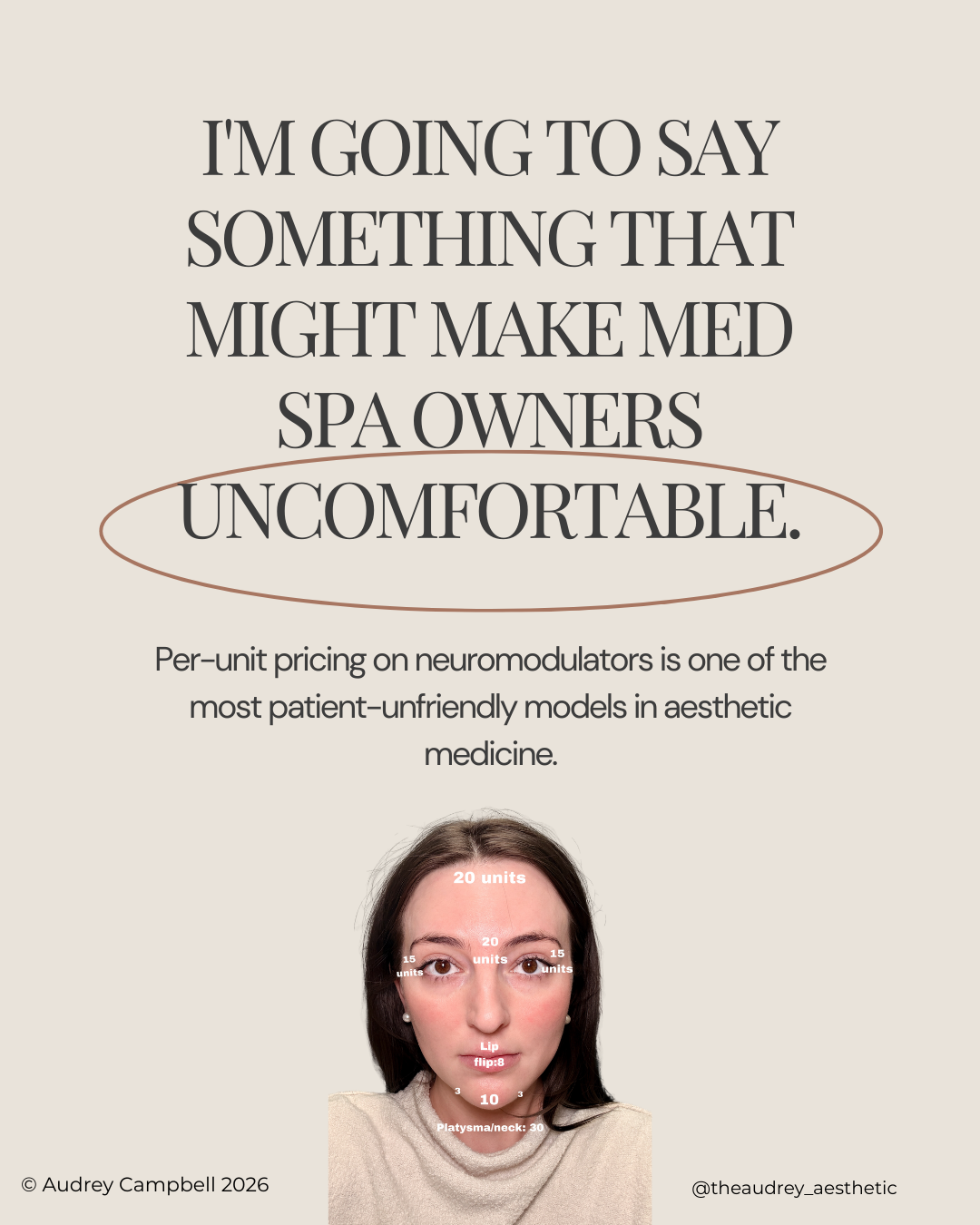
There is a conversation happening inside aesthetic practices that almost no one is documenting. It goes like this: a patient sits down for a consultation, you discuss their goals, you build a treatment plan — and then they ask how many units it will take.
From that moment forward, the clinical conversation is over. What replaces it is a negotiation.
Per-unit pricing is one of the most widely accepted billing structures in aesthetic medicine. It is also, I would argue, one of the most quietly damaging — not because it doesn’t work financially, but because of what it does to the dynamic between provider and patient the moment money enters the room.
This post is about that dynamic. And about what changes when you remove it.
The Pricing Model Is Setting the Agenda
When patients pay per unit, the unit becomes the negotiable variable. Not the outcome. Not the treatment goal. The unit count.
This creates a predictable set of behaviors:
- Patients ask what the minimum is to see a result
- They ask whether you can ‘start with fewer and add more later’
- They compare your per-unit rate to a competitor they found on Google
- They make decisions based on what they can spend today rather than what the treatment requires
None of this is the patient’s fault. You told them the price was per unit. You gave them a variable to pull on.
The real problem isn’t that patients are being unreasonable — it’s that the pricing model trained them to behave this way.
What Under-Dosing Actually Costs You
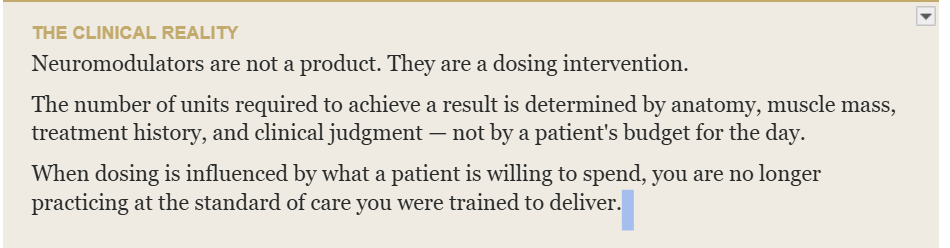
The downstream consequences of a negotiated treatment are almost always invisible to the provider in the moment. The patient leaves satisfied — they paid less than they expected. The problem surfaces two to three weeks later.
Under-dosed neuromodulator treatments present with:
- Incomplete relaxation in the treated area
- Asymmetry where full correction would have been symmetric
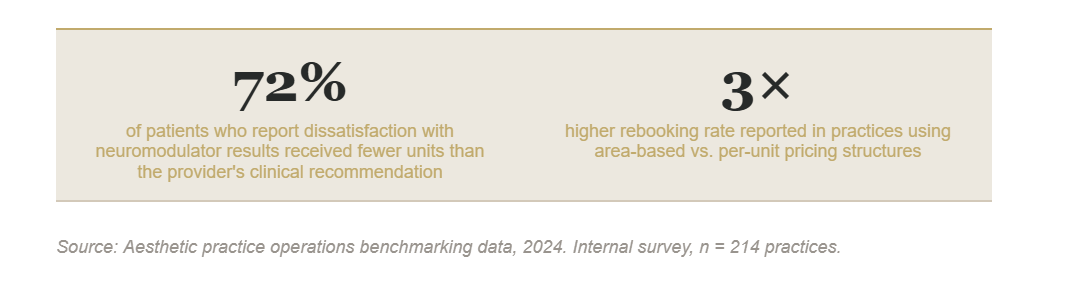
- Shorter duration, leading to earlier rebooking — or no rebooking at all
- Patient-reported dissatisfaction attributed to the product or the provider, not the dose
That last point is the one worth sitting with. When a patient leaves under-treated, they rarely return and say “I think we should have used more units.” They say the treatment didn’t work. They write a review that says it didn’t last. They book with someone else.
You gave a discount. They took it. And you absorbed all of the reputational cost.
Treatment-Based Pricing: What It Is and What It Isn’t
Treatment-based pricing means you price by area treated or by outcome — not by the number of units delivered. The patient knows what they’re paying for a forehead treatment, or a brow lift, or a full upper-face correction. The unit count is clinical information. It never enters the conversation.
This is not a new concept. Surgeons don’t charge by the stitch. Dentists don’t charge by the milliliter of anesthetic. Dosing is a clinical decision, and the patient pays for the result.
What this model is not:
- It is not a way to obscure your costs or hide what you’re doing
- It is not a premium pricing strategy for luxury positioning alone
- It is not something that requires a complete rebrand to implement
It is a structural change to how the financial conversation is framed — one that protects the clinical relationship, protects the outcome, and incidentally, protects your revenue.
The Operational Shift: A Staged Rollout
Practices that have made this transition successfully tend to follow a similar sequence. The goal is to protect existing patient relationships while creating the conditions for the new model to work at scale.
PHASE 1 — INTERNAL ALIGNMENT (WEEKS 1–2)
- Audit your current per-unit pricing against your standard dosing protocols for each area
- Build flat-rate pricing for your most commonly treated areas: forehead, glabella, crow’s feet, brow lift, lip flip
- Ensure your flat-rate includes your clinical dosing recommendation — not a reduced amount
- Train your team on how to present the new structure before it goes live with patients
PHASE 2 — LANGUAGE AND CONSENT (WEEKS 3–4)
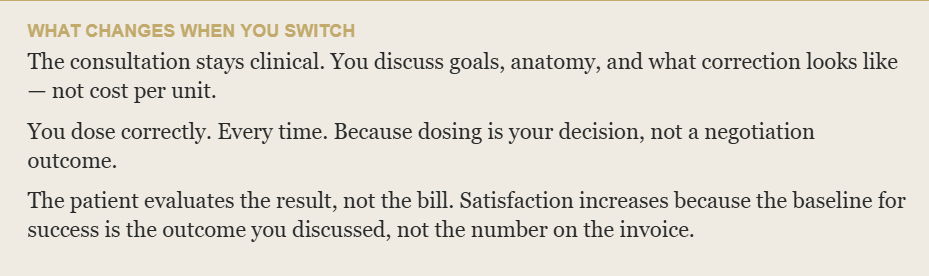
- Update consultation scripts to center outcomes, not units
- Revise consent documentation to reflect area-based pricing and clinical dosing decisions
- Build a patient FAQ that addresses the most common questions: ‘What if I don’t need as many units?’ / ‘Can I pay for less and see how it looks?’
- Prepare your front desk team to answer pricing questions before the clinical consultation begins
PHASE 3 — PATIENT COMMUNICATION (WEEK 5+)
- For existing patients: introduce the change framing it as an upgrade to your treatment structure, not a price increase
- Emphasize that their results will be more consistent because dosing is now fully clinical
- For new patients: present the model as standard from day one — no transition conversation required
- Track rebooking rates, follow-up satisfaction, and review sentiment in the 90 days following transition
The Conversation You’ll Need to Have
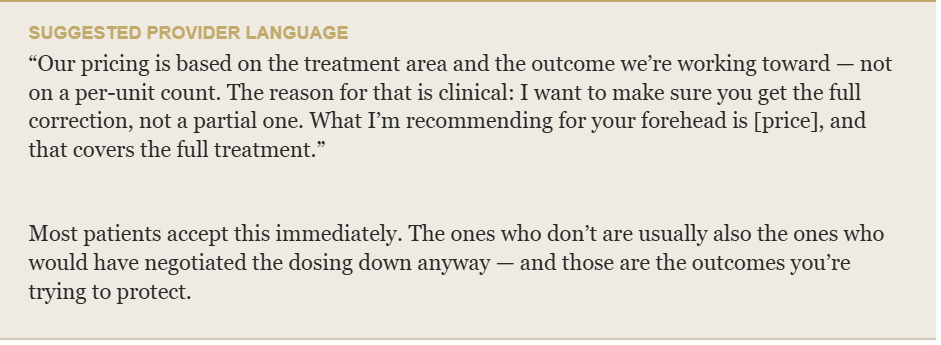
Some patients will push back. They’ve been trained by the industry — and possibly by your practice — to ask about units. When they do, the response is simple:
What This Looks Like at Scale
For practices managing high volume — 40 to 60 neuromodulator treatments per week — the operational benefit compounds quickly. When the unit count is not a conversation variable, consultations are shorter. Consent is cleaner. Follow-up concerns decrease. And the provider is no longer negotiating dosing decisions in real time.
For PE-backed or multi-location groups, this is also a material standardization lever. Inconsistent dosing across providers — often driven by inconsistent patient-negotiated treatments — is one of the quieter sources of outcome variance between locations. Area-based pricing with protocol-tied dosing creates consistency that individual provider judgment alone cannot guarantee.
The Model Aesthetic Medicine Should Be Building Toward
Patients do not walk into a cardiologist’s office and negotiate the milligram count on their prescription. They describe their symptoms. The provider recommends a dose. The pharmacist fills it.
Aesthetic medicine has spent twenty years building an industry around the language of luxury and clinical excellence. Per-unit pricing is a structural holdover from a time when the industry was still figuring out what it was. We know what it is now.
The practices winning on outcomes, retention, and reputation are not the ones offering the lowest per-unit rate. They are the ones where the clinical conversation never got interrupted by a financial one.
That is the model worth building toward. And the shift to get there is more operational than it is philosophical.
You already know how to dose correctly. The question is whether your pricing structure is letting you.
Operational intelligence for aesthetic practices, PE groups, and lenders evaluating the medical aesthetics industry.
substack.com/aestheticallyaudrey · @theaudrey_aesthetic