Most aesthetic practices grow through acquisition.
They spend on ads, build social proof, invest in PR, and convert a percentage of the traffic into patients. It works—until it doesn’t.
The problem with acquisition-driven growth is that it’s linear. More patients require more marketing spend. More marketing spend requires better conversion rates. Better conversion rates require more operational capacity. Eventually, you hit a ceiling where the cost of growth exceeds the return.
Sustainable growth doesn’t come from getting more patients. It comes from designing patient journeys that compound.
The practices scaling past $5M in revenue—especially in plastic surgery and wellness—aren’t the ones with the best social media presence. They’re the ones who understand that growth is structural, not promotional.
The Growth Levers Most Practices Ignore
Consult-to-Procedure Conversion: 64%
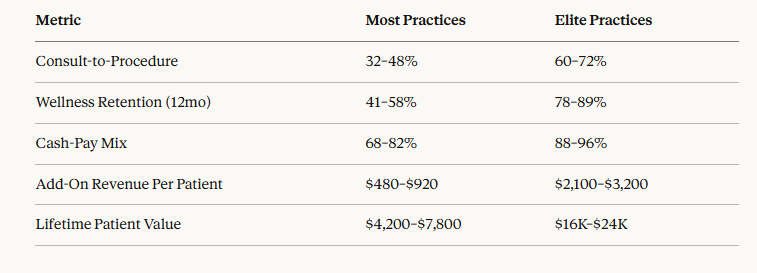
High-converting practices book procedures from 64% of consultations. Most practices convert 32–48%.
This gap represents millions in lost revenue. A practice running 20 consultations per month at 35% conversion completes 7 procedures. At 64% conversion, that’s 13 procedures—nearly double.
The difference isn’t price. It’s process.
Low-converting consultations are informational. The provider answers questions, explains options, and leaves the decision to the patient. High-converting consultations are transformational. The provider guides the patient to see themselves differently and makes the procedure feel inevitable.
When conversion is low, it’s because your consultation is focused on the wrong outcome. The goal isn’t to close the sale. It’s to build conviction.
Wellness Program Retention: 84%
Practices with structured wellness programs—IV therapy, hormone optimization, weight management, longevity protocols—retain 84% of enrolled patients at 12 months. Most practices see 41–58% retention.
This matters because wellness revenue compounds. A patient on a 12-month hormone protocol generates $8K–$14K annually. A patient who comes in for an IV drip generates $400 once.
High-retention wellness programs aren’t built on one-off services. They’re built on protocols that require ongoing engagement. The patient isn’t buying a treatment. They’re buying a transformation that unfolds over time.
When retention is low, wellness is positioned as optional. High performers position it as essential.
Cash-Pay Mix: 91%
Elite practices generate 91% of revenue from direct-pay patients, not insurance. Most practices hover around 68–82%.
Cash-pay patients are more profitable, more compliant, and more loyal. They’re paying for an outcome, not filing a claim. They’re invested in the result because they’re invested financially.
Practices with high insurance dependency are constrained by reimbursement rates, administrative overhead, and patient expectations shaped by coverage limits. Cash-pay practices set their own prices and design their own services.
When cash-pay mix is low, it’s because the practice hasn’t built a service offering valuable enough to justify direct payment. The fix isn’t better marketing. It’s better service design.
Add-On Revenue Per Patient: $2,340
High-performing practices generate an average of $2,340 in additional revenue per patient from complementary services. Most practices generate $480–$920.
Add-on revenue isn’t upselling. It’s service architecture that creates natural progression. A facelift patient who also receives skin resurfacing, ongoing skincare, and wellness optimization isn’t being sold. They’re being cared for comprehensively.
When add-on revenue is low, it means your services exist in silos. There’s no connective tissue. Patients don’t see how one treatment complements another because you’re not showing them.
Lifetime Patient Value: $18,600
Elite practices generate an average of $18,600 per patient over the lifetime of the relationship. Most practices generate $4,200–$7,800.
This is the metric that determines whether your growth compounds or resets every quarter. High LTV practices don’t depend on new patient volume. They extract more value from each patient over time.
Low LTV means you’re running a transactional practice. Patients come in, receive a service, and leave. High LTV means you’re running an ecosystem. One service leads to the next. Patients stay engaged for years.
Benchmark Summary
What Breaks When These Levers Are Ignored
Practices that don’t build for LTV stay trapped in acquisition mode. They’re always chasing the next cohort of patients because the current cohort doesn’t generate enough ongoing revenue.
This creates operational stress. Marketing costs stay high. Patient churn stays high. Revenue feels unpredictable.
The business grows in volume but not in stability. And eventually, volume growth slows. Competition increases. Margins compress.
Sustainable practices don’t scale through volume. They scale through value density. They extract more from each patient relationship, which reduces dependence on constant acquisition.
Strategic Takeaway
Growth isn’t about getting more patients through the door. It’s about designing patient journeys that don’t end.
High performers in plastic surgery and wellness build ecosystems where one service naturally leads to the next. Consultation converts at high rates because it’s structured to build conviction. Wellness programs retain because they’re protocols, not one-time treatments. Add-on revenue is high because services are architecturally connected.
The practices that scale aren’t the loudest. They’re the ones who understand that growth is structural, not promotional.
Build for lifetime value. The rest will follow.