There’s a persistent myth in the aesthetic industry that success comes from location, brand recognition, or some mysterious ability to “attract the right clientele.”
It doesn’t.
The practices generating the highest revenue per patient, maintaining the best retention rates, and operating with the healthiest margins share something far more concrete: operational discipline you can measure.
The difference between a practice doing $2M annually and one doing $6M with the same square footage and patient volume isn’t luck. It’s execution across five specific performance areas.
The KPIs That Separate Performers
Revenue Per Visit: $847
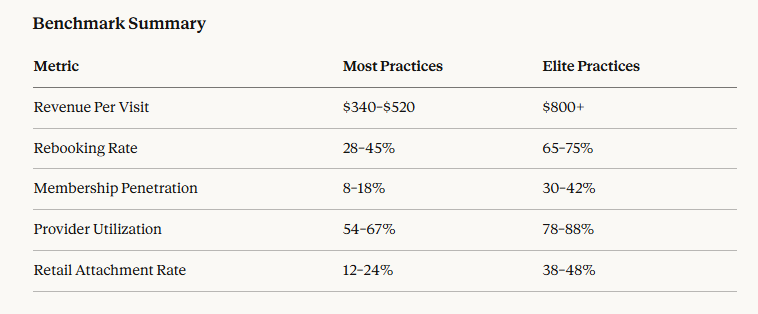
Most aesthetic practices generate between $340 and $520 per patient visit. Top-quartile practices average $847. Elite practices consistently exceed $1,000.
This isn’t about charging more for the same service. It’s about service design that creates more value per interaction—treatment plans instead of one-off appointments, strategic bundling, and retail integration that feels like care, not sales.
When revenue per visit is low, it’s usually because the practice is operating as a service vendor rather than a transformation partner. The appointment becomes the product, not the outcome.
Rebooking Rate: 68%
High-performing practices see 68% of patients schedule their next appointment before leaving. Most practices see 28–45%.
This metric reveals everything about your patient experience, provider confidence, and operational systems. When rebooking rates are low, it means one of three things: your providers aren’t trained to recommend ongoing care, your services don’t naturally sequence, or patients don’t trust the value enough to commit.
Rebooking isn’t about pressure. It’s about making the next step obvious and building it into the visit structure.
Membership Penetration: 34%
At elite practices, 34% of active patients are enrolled in membership or subscription programs. Most practices sit between 8–18%.
This gap represents the difference between transactional revenue and compounding revenue. Membership patients spend 2.8x more annually, visit 3.2x more frequently, and refer at twice the rate of non-members.
When membership penetration is low, it’s because the program is positioned as a discount instead of a VIP access model. Discounts attract price sensitivity. Access attracts commitment.
Provider Utilization: 82%
Top practices convert 82% of available provider hours into billable time. Most practices hover around 54–67%.
This is where operational efficiency meets revenue potential. Gaps in utilization come from poor scheduling systems, inadequate demand, or misaligned service offerings.
The fix isn’t more providers. It’s better capacity management and service architecture that keeps existing providers productive.
Retail Attachment Rate: 41%
High performers see 41% of service appointments include a product purchase. Most practices see 12–24%.
Retail attachment isn’t about selling skincare. It’s about extending the treatment result beyond the appointment. When attachment rates are low, it’s because retail is positioned as optional rather than integral to the care plan.
Elite practices don’t separate service from product. They build treatment protocols that require both.
Benchmark Summary
What Breaks When These Metrics Are Ignored
Practices that don’t track these KPIs make decisions based on activity instead of outcomes. They hire more providers when utilization is the problem. They increase marketing spend when retention is broken. They discount services when value presentation is weak.
The result is a business that feels busy but doesn’t grow. Revenue plateaus. Margins compress. Staff turnover increases because the operational stress never resolves.
The aesthetic industry rewards precision. Most practices are operating on instinct and calling it strategy.
Strategic Takeaway
High performance in aesthetics isn’t about working harder or attracting different patients. It’s about extracting more value from every interaction through deliberate service design, retention infrastructure, and measurement discipline.
The gap between good and great is operational, not aspirational.
Track the metrics. Fix what’s broken. Stop guessing.