A patient has a vascular occlusion at their appointment.
The next day, the system sends a rebooking reminder. The day after, a five-star review request.
That is the communication you never want going out.
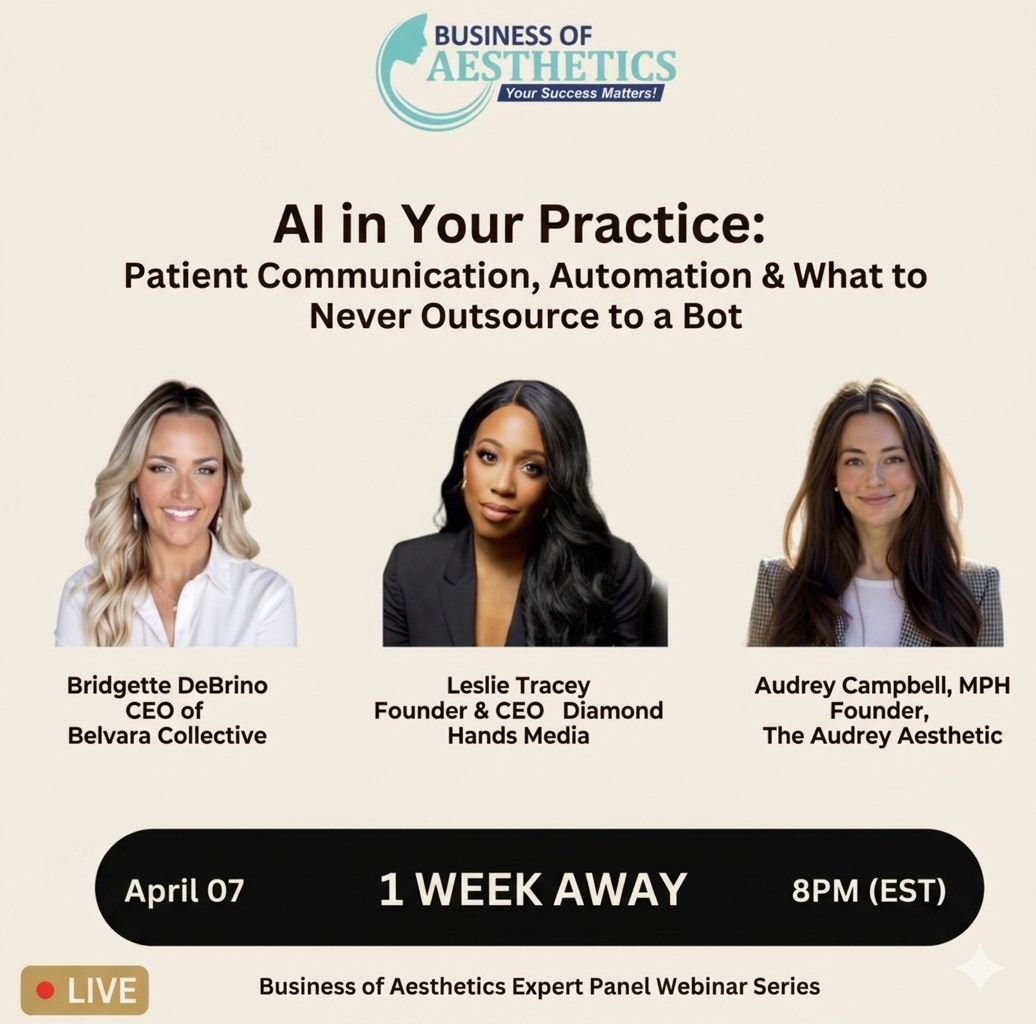
This came up last week when I joined Leslie Tracy and Bridget DeBrino on the Business of Aesthetics panel with Don Adisha. We covered a lot of ground: where AI is already running inside your practice, what is actually safe to automate, and what the one metric is that tells you whether any of it is working.
The vascular occlusion scenario is the one I want to start with, because it is the thing most practices have not solved for. And it is the difference between a system that runs your operations and a system that runs into your patients.
1. There needs to be a flag.
Every EMR and communication platform I work with has the ability to stop all automated messages for a single patient with one toggle. Pabau. Meevo. PatientNow. Jane App. Boulevard. The feature is there. Most practices have never configured it, and most staff do not know it exists.
It works like this. When something goes wrong at an appointment, a complication, a complaint, an escalated clinical moment, someone flags the patient in the system. All automated messages stop firing to that person. No rebooking reminder. No review request. No re-engagement sequence. Nothing automated goes out until a human says it can resume.
You need a point person to trigger it. One human. Authorized. Trained. With a named backup. If the trigger depends on the provider remembering during a stressful moment, it will not happen. Build the handoff. Document who owns it.
And please, do not put the clinical reason inside the trigger itself. You do not need to tell the system why the patient is flagged. You just need to tell it to stop. The reason lives in the chart.
2. Book it yourself before a patient does.
Bridget made this point on the panel and it is the one I would want every operator to hear twice. You cannot evaluate an automation from the vendor demo. You have to live inside it.
Book yourself an appointment through your own funnel. Close it. Cancel it. Reschedule it. Flag it as a complication. Read every text that comes through. Open every email. Listen to every voicemail.
Then have your staff do the same. Injectors run through the injector flow. Medical directors run through the complication flow. Front desk runs through the booking flow. The people doing the job every day will find things a demo will never show you.
It feels slow. One day to fully sandbox an automation layer across five appointment types with six team members feels expensive. It is the cheapest day you will ever spend. The alternative is finding the problem when a live patient does.
And while you are testing, pay attention to whether the system is actually learning. If you cannot tell the difference between what it is doing now and what an automated text message did three years ago, you have not bought AI. You have bought a worse version of manual.
3. One metric. Rebooking rate.
I get asked constantly which metric tracks whether an AI investment is working. There is one answer. It is rebooking rate.
Not leads generated. Not hours saved. Not tickets closed. Not open rates. Rebooking rate is the number that tells you whether your automation is doing the job, whether your patient experience is holding, and whether your communication cadence is earning the return visit.
Benchmarks operators should know:
- Industry average: 38 to 42 percent.
- Best-in-class without AI: around 65 percent.
- Best-in-class with AI: 75 to 80 percent, and higher.
That spread is the whole reason AI matters in aesthetics. A practice moving from 40 percent rebooking to 70 percent is nearly doubling return visit revenue from the same patient base. The ROI is not the minutes of staff time saved. It is what happens to your revenue over twelve months when more patients come back.
Treat the AI like a new hire. You would not bring on a new employee and never measure their performance. Do not buy AI that way either.
Check in at 30 days. Is it firing? Is it flagging correctly? Check in at 60 days. Is it learning? Has rebooking moved? Check in at 90 days. Keep, adjust, or kill. Name the decision. Write down the reason.
4. Start with the problem, not the tool.
Someone on the panel asked about solo location owners feeling overwhelmed by the pace of new AI tools coming out. Same answer I give every multi-location operator I consult with.
What is plaguing your practice right now? If your rebooking rate is already 70 percent, rebooking automation is your last priority. If you are losing half your leads because nobody answers the phone after 6 PM, that is your first priority. Pick the one thing costing you the most money or the most patient trust. Evaluate tools against that problem.
Start with one. Measure it at 30, 60, 90. Add the second tool only after the first has earned it. This is the discipline that separates practices that actually operationalize AI from practices that accumulate a stack of half-used subscriptions.
5. The part I keep coming back to.
Leslie said something near the end of the panel that I have not been able to stop thinking about.
The practices that win are not going to have every AI stack in the damn world. They are going to be showing up in person. Everyone is going to start looking the same. Captions are the same. Tools are the same. Voice is the same. The practices that win are going to cultivate their voice, their team’s voice, and their community presence.
I have been saying a version of this for a year. AI is infrastructure. It makes consistent execution cheap. What it does not do, what it will never do, is build the relational depth that turns a patient into a referral source. That is human work. Slow, expensive, and the thing AI is making more valuable, not less.
The practices with the best infrastructure and the most human presence are going to pull away. Not the ones with the most tools. The gap is going to widen over the next eighteen months.
6. Four things to do tomorrow.
If you read nothing else in this post, do these four things before the end of the week.
- Call your EMR and your CRM. Ask what AI features are active on your account. Write the answer down.
- Configure the escalation flag on both systems. Name the point person. Train the handoff. Test it once.
- Sandbox the patient journey. Book an appointment. Close it. Watch what fires. Have one person from each department do the same in their workflow.
- Choose your primary metric. Rebooking rate. Pull the current number. Set calendar holds for 30, 60, and 90 days from today to review it.
Four steps. No new software. No budget approval required. You can complete it this week.
The practices I work with that treat AI as an operational discipline, not a shopping trip, are the ones that show up in the top quintile of rebooking rates a year from now. The ones treating it as a shopping trip stay where they are.
PANEL
Business of Aesthetics expert panel, hosted by Don Adisha. Featuring Leslie Tracy of Diamond Hands Media, Bridget DeBrino of Belvara Collective, and me.
IF THIS WAS USEFUL
Forward it to one operator who needs the flag configured. That is the share that moves the industry.
Audrey Campbell, MPH · Founder, The Audrey Aesthetic
theaudreyaesthetic.com · @theaudrey_aesthetic · theaudreyaesthetic.substack.com