Most people who say they use AI have never touched one. You type into a box, an answer comes back, and it feels like the thing belongs to you. It doesn’t. When you open ChatGPT, Claude, or Gemini, the model sits on the company’s servers and you rent a seat. You can use it well. You can’t see how it works, you can’t change it, and the company can raise the price or retire the version you built on whenever it decides to.
That was the only arrangement on offer for a long time. This summer it stopped being the only one, and the person who changed it is worth knowing about.
The news
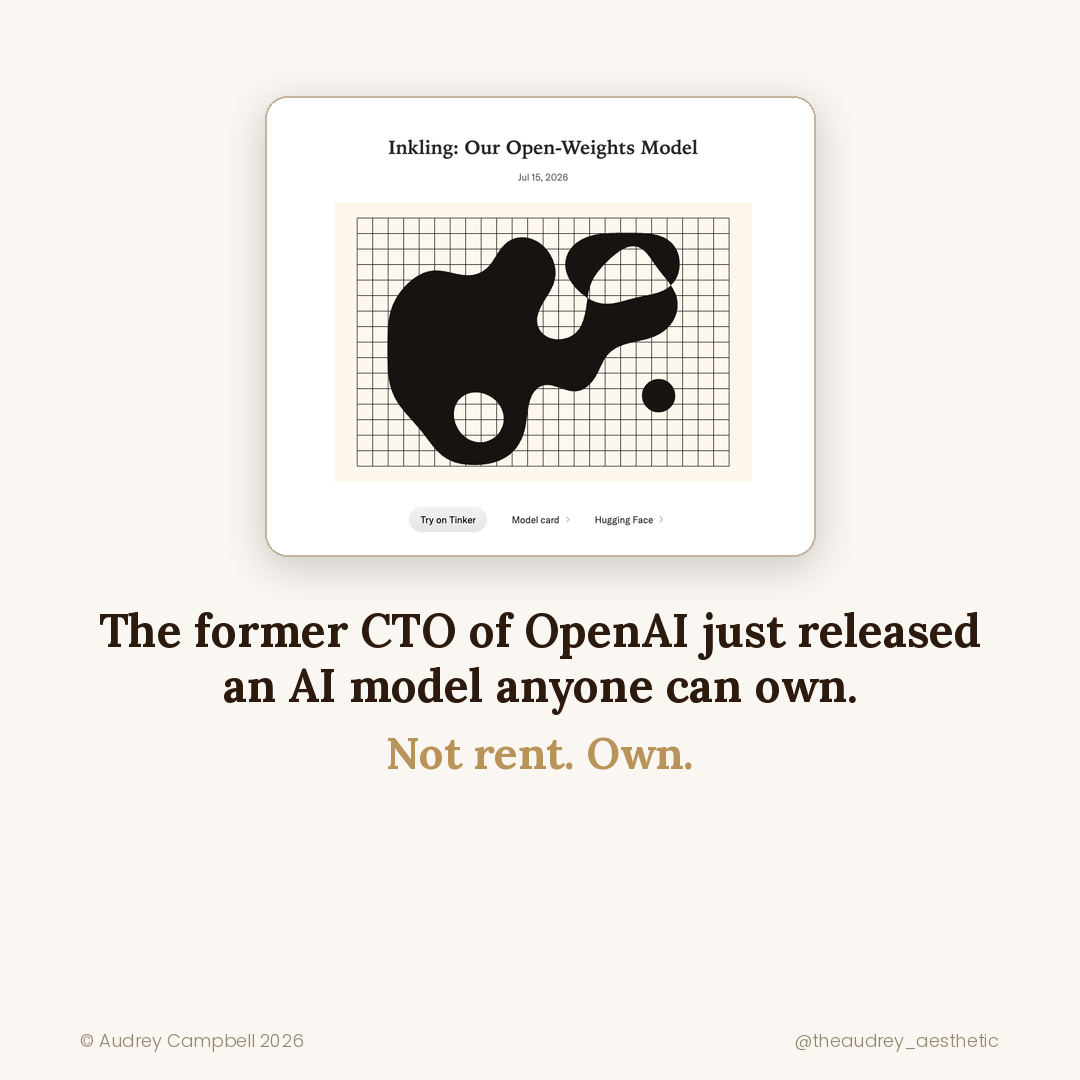
Mira Murati was the chief technology officer of OpenAI. She left in 2024 and started a lab called Thinking Machines. On July 15 the lab released its first model, Inkling, and published the full weights for anyone to download.
A model’s weights are the billions of numbers it settled on during training. They hold everything it learned. Most labs keep that file on their own machines and rent you access to it, which is what a closed model is. When a lab publishes the weights, the file is yours. You can run it on hardware you control, fine-tune it on your own data, and keep using it no matter what the company does next. That is an open-weight model, and Inkling is one.
The specs are serious. Inkling is a mixture-of-experts model with 975 billion total parameters. It works across text, images, and audio, and it reads up to a million tokens of context at once. The full weights are on Hugging Face today.
The part that surprised me
Thinking Machines said, in writing, that Inkling is not the strongest overall model available today, open or closed. Most launches claim the opposite. This one didn’t, and the reason is the whole argument.
They aren’t betting that one enormous model wins every task. They’re betting that companies would rather own a capable model they can shape for their exact work, on hardware they control, with data that never leaves the building, than rent a slightly smarter one they will never see inside. The model is free. Thinking Machines makes its money on Tinker, its paid service for fine-tuning. Their own case for why this matters is blunt: many real problems aren’t solved well by even the best general model, and the gap closes when you train it on your own specialized knowledge.
The Ownership Test
You don’t need to download a 975-billion-parameter model to use what’s happening here. You need a way to tell, for any AI you depend on, whether you own the capability or rent it. Three questions do the job.
The Ownership Test
Before you build anything important on an AI model, ask:
1. Can the vendor turn it off?
2. Can the vendor change the price or swap the model underneath you?
3. Does your data have to leave your building for it to work?
A “yes” you can’t prevent means you are renting that capability, not owning it.
Renting isn’t automatically wrong. I rent plenty. But you should know which of your important workflows sit on rented ground, because the rent can change and the landlord can leave.
Why this lands for owners
Most practices are not going to run a model this size in house, and I wouldn’t tell them to. The reason to track this is narrower and more useful. Renting hurts most where your data is sensitive and where a vendor disappearing would cost you real money. In this field that means patient information and the systems your front desk and clinical teams use every day. Every consumer AI account someone opens to help with charting is rented ground, and it is the kind that carries compliance exposure.
Open weights won’t fix that next week for a single-location practice. What they change is the direction. The option to own the model, keep the data in house, and stop living at the mercy of a vendor’s roadmap used to belong only to the largest companies. It is moving down-market. When it reaches tools built for this field, and it will, the owners who already know which parts of their stack they rent will move first.
The bigger picture
Right now a small number of American companies rent AI to most of the world. Open weights loosen that grip. Once a weights file is public it cannot be recalled. It gets copied, run, and fine-tuned in places the original lab will never see. Inkling is one file. There will be more.
The takeaway is not that you need to act this week. It is that owning your AI is becoming a real answer to a question that had only one answer a year ago. Know which parts of your business run on rented AI. Watch what becomes ownable. Move when it is yours to move on.
Warmly,
Audrey
Originally published on Substack.